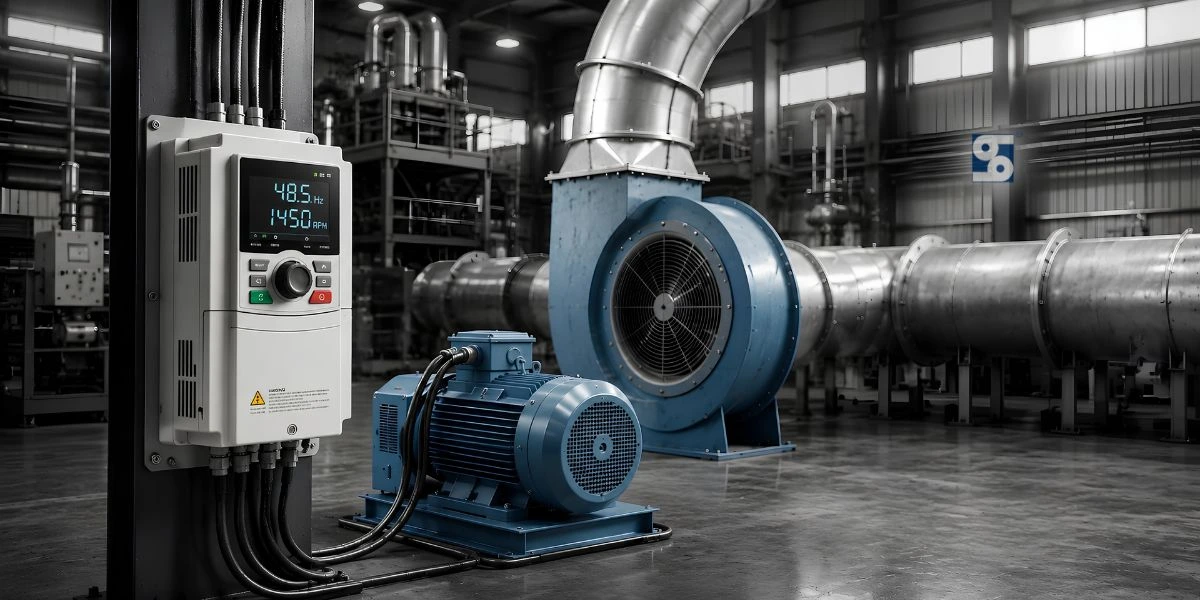
Industrial fans and blowers support essential processes such as ventilation, cooling, exhaust, dust collection, combustion, and pneumatic conveying. These systems do not always require the same airflow throughout the production cycle.
Running a fan at full speed when demand is low can waste energy. It can also reduce process control. Variable Frequency Drives provide a practical way to adjust fan speed according to actual requirements.
A VFD changes the frequency and voltage supplied to the motor. This allows the connected fan or blower to operate at different speeds.
For industrial plants, this means better airflow control, smoother starting, and potential energy savings. However, the VFD must work with the right fan, motor, and system design.
How Variable Frequency Drives Control Industrial Fans
A Variable Frequency Drive controls motor speed by changing the electrical frequency supplied to the motor. When airflow demand increases, the fan can operate at a higher speed. When demand decreases, the VFD can reduce speed.
This approach differs from fixed-speed operation with damper control. A damper restricts airflow while the fan continues operating at its existing speed.
Speed control can be more suitable when airflow requirements change frequently.
The final result depends on the fan curve, system resistance, motor characteristics, operating range, and process requirements.
How VFDs Improve Industrial Fan Efficiency
Fan speed has a major effect on power consumption. Basic fan laws show that airflow changes approximately in proportion to speed. Pressure changes approximately with the square of speed. Power changes approximately with the cube of speed.
This makes speed control valuable in variable-demand applications.
For example, a fan that operates below full speed for extended periods may consume significantly less power than a fan that continuously operates at full speed. Actual savings depend on the complete system and operating conditions.
Engineers can use a fan laws calculator to understand how changes in fan speed affect airflow, pressure, and power.
Why Static Pressure Matters
Static pressure is an important factor when selecting an industrial fan and VFD system.
Ducts, filters, dampers, bends, dust collectors, and other components create resistance. The fan must overcome this resistance while delivering the required airflow.
Static pressure in industrial ventilation helps engineers establish the correct operating point.
A VFD can adjust fan speed, but it cannot compensate for an incorrectly selected fan. The fan must still meet the required airflow and pressure at the intended operating condition.
VFDs and Centrifugal Blowers
Centrifugal blowers are widely used for industrial exhaust, ventilation, cooling, combustion, and process applications.
Their operating point depends on the relationship between the fan performance curve and system resistance.
Variable Frequency Drives allow the blower to operate at different speeds. This can help control airflow and pressure when process conditions change.
The blower and motor must support the required speed range. Engineers should also consider temperature, gas composition, drive arrangement, bearings, and duty conditions.
For applications involving aggressive chemicals or corrosive gases, material selection becomes equally important. Corrosion-resistant fan solutions can help address demanding operating environments.
Industrial Applications of VFD-Controlled Fans
VFD-controlled fans support many industrial processes.
Cement plants use fans for ventilation, cooling, combustion, and dust handling. Airflow requirements can change with production conditions.
Steel plants use industrial fans for combustion air, exhaust, cooling, and process ventilation.
Textile plants use fans for ventilation and air circulation. Fan output can change with production requirements.
Pharmaceutical facilities require controlled ventilation and pressure conditions. Variable speed operation can support changing airflow requirements.
Chemical plants use exhaust and ventilation systems that may experience changing process loads.
Wastewater treatment facilities use ventilation and odor-control systems where airflow demand can vary.
Industrial blowers also support cooling applications. Selecting the right fan depends on heat load, airflow, temperature, and process conditions. Industrial blower fan applications for cooling processes provide useful context for these systems.
When an Industrial Fan Needs a VFD
A VFD can be valuable when:
- Airflow demand changes frequently
- Static pressure requirements vary
- Production rates change
- The fan operates at partial load
- The system relies heavily on dampers
- Automatic airflow control is required
- Energy consumption is a major operating cost
Fan type also matters. Different systems use different fan configurations based on airflow, pressure, and application requirements. Industrial fan configurations used in HVAC systems help engineers evaluate suitable equipment.
Can an Existing Blower Use a VFD
A VFD retrofit can be possible for an existing industrial blower. However, the complete system should be evaluated first.
Important checks include:
- Motor power and voltage
- Motor current
- Motor condition
- Fan operating range
- Minimum and maximum speed
- Bearing arrangement
- Belt or coupling drive
- Fan curve
- Electrical system
- Existing control system
A VFD does not solve mechanical problems. Vibration, worn bearings, damaged belts, poor alignment, and impeller issues should be addressed first. Industrial fan failure problems and their causes can help identify existing equipment issues.
Parameters to Check Before VFD Selection
Engineers should provide accurate application data before selecting a VFD-controlled fan.
Key information includes:
- Required airflow
- Static pressure
- Total pressure
- Fan speed
- Motor power
- Motor voltage
- Gas temperature
- Gas composition
- Required speed range
- Operating hours
- Duty conditions
- Installation environment
This information helps ensure the fan, motor, and VFD work together correctly.
For technical guidance on fan performance and industry standards, engineers can also refer to AMCA International, a recognized industry organization that develops standards and technical resources for fans and air systems.
Evaluating VFD Investment
B2B buyers should consider more than the initial VFD cost.
The evaluation should include:
- Equipment cost
- Installation cost
- Electrical integration
- Energy consumption
- Maintenance
- Operating hours
- Downtime
- Expected service life
Energy savings can be significant in suitable variable-demand applications. However, the actual payback depends on the operating profile.
A complete total-cost-of-ownership assessment gives plant managers and procurement teams a better basis for investment decisions.
What to Share for Fan Selection
A manufacturer needs accurate application data to recommend the right fan and VFD configuration.
Before requesting a quotation, provide:
- Required airflow
- Static pressure
- Gas temperature
- Gas composition
- Motor power
- Operating hours
- Duty conditions
- Installation environment
- Required fan speed
- VFD requirement
Accurate information reduces the risk of selecting an unsuitable or oversized system.
Frequently Asked Questions
Can Variable Frequency Drives reduce industrial fan energy consumption?
Yes. They can reduce energy use when the fan operates at lower speeds during periods of reduced demand. Actual savings depend on the complete system.
Can a VFD control a centrifugal blower?
Yes. A suitable VFD can control a centrifugal blower when the motor and blower support the required speed range.
Is a VFD better than a damper?
A VFD can be more efficient for variable-demand applications because it changes fan speed instead of relying only on airflow restriction.
Can an existing blower be converted to VFD operation?
It may be possible. Motor compatibility, fan speed range, mechanical condition, and electrical requirements should be evaluated first.
Choose the Right Industrial Fan and VFD Solution
Variable Frequency Drives provide valuable speed control for industrial fans and blowers. They help match fan output with process demand while supporting smoother operation and potential energy savings.
However, the VFD is only one part of the system. Proper fan selection, motor sizing, pressure calculations, operating range, and control strategy all affect performance.
Planning a VFD-controlled industrial fan or blower system? Contact Blowerfab with your required airflow, static pressure, motor rating, operating temperature, and duty conditions. Get the right industrial blower and Variable Frequency Drive configuration for your application.