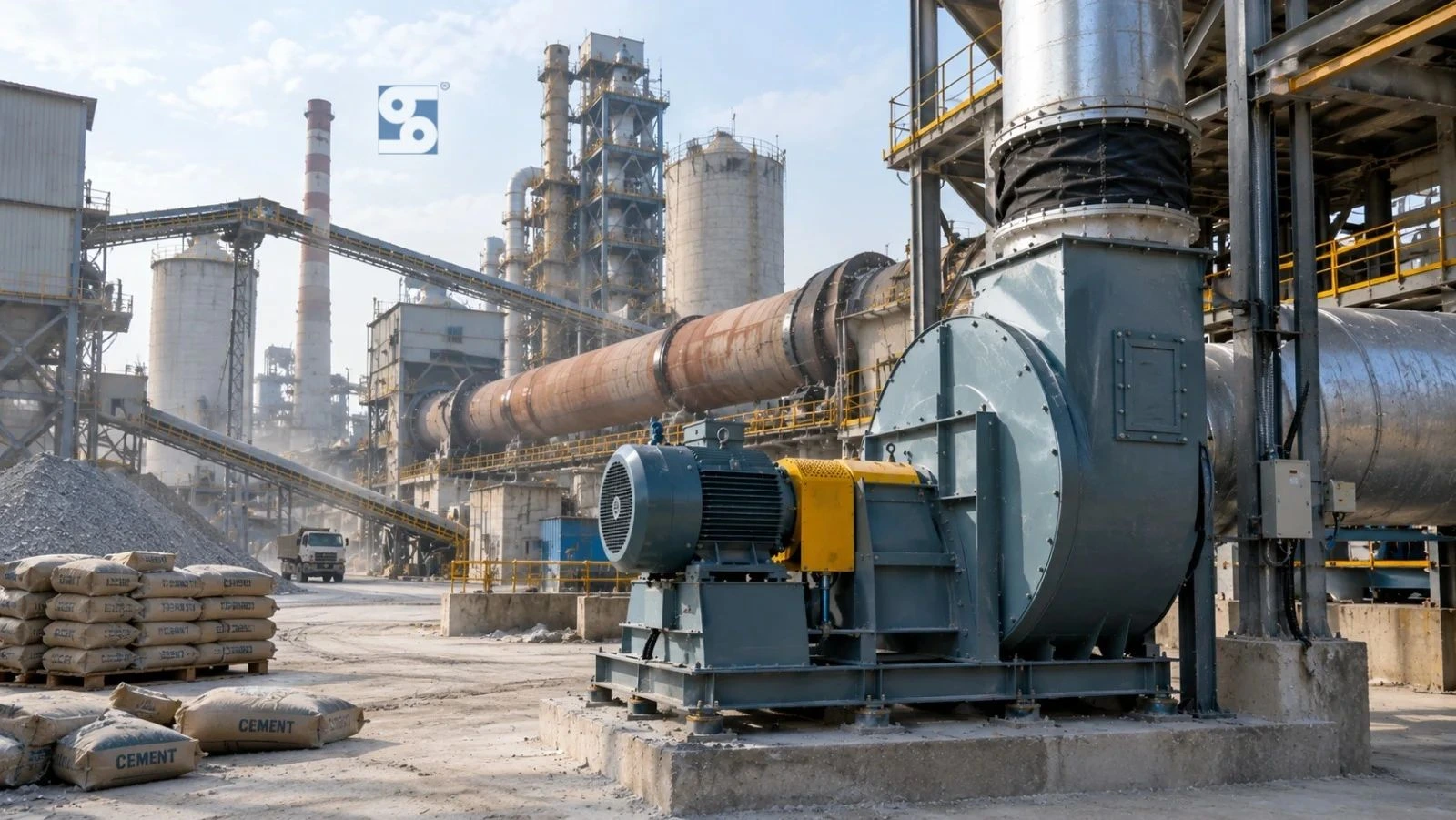
Cement plants operate under demanding conditions. They handle abrasive materials, high temperatures, dust, and continuous production cycles. Every process depends on controlled air movement. The wrong fan can reduce airflow, increase energy use, and affect process performance.
Choosing Industrial Fans for Cement Plants therefore requires more than checking airflow capacity. Engineers need to consider pressure, temperature, dust load, fan type, efficiency, operating speed, and installation conditions.
Understanding industrial fan and blower systems can also help engineers evaluate airflow requirements, system performance, and energy efficiency when selecting the right fan for a specific cement plant application.
Understand the Airflow Requirement
Airflow is one of the first factors to consider when selecting Industrial Fans for Cement Plants. The fan must deliver the required air volume for the application.
Airflow is usually expressed in cubic metres per hour or cubic metres per second. The required value depends on the process and equipment connected to the fan.
A fan with insufficient airflow may fail to remove heat, dust, or process gases effectively. An oversized fan can consume unnecessary power and may operate away from its best efficiency point.
Start with the actual process requirement. Then match the fan capacity with the system design.
Check the Required Static Pressure
Airflow alone does not define fan performance. Static pressure also plays a major role.
Cement plants often use long duct runs, filters, cyclones, dampers, separators, and dust-collection systems. Each component creates resistance.
The selected fan must overcome the total system resistance while maintaining the required airflow.
When engineers select Industrial Fans for Cement Plants, they need to calculate pressure losses across the complete system. This approach provides a more reliable selection than choosing a fan based only on motor power or airflow.
A fan curve also helps compare airflow and pressure at different operating points.
Select the Right Fan Type
Different cement plant processes require different fan designs. Centrifugal fans are widely used where the system requires higher pressure and controlled process airflow.
Radial-bladed fans suit applications where the air contains dust or particulate matter. Their blade design supports demanding industrial conditions.
Backward-curved centrifugal fans offer strong efficiency and stable operation in suitable clean-air or controlled-air applications. They can support processes where energy efficiency remains an important consideration.
Axial fans suit applications that require high airflow with relatively lower pressure. They can support general ventilation, cooling, and air movement.
The key is to match the fan design with the process rather than selecting one fan type for every application.
Consider Dust and Abrasive Particles
Dust is a major concern in cement manufacturing. Raw materials, clinker, cement, and other process materials can create abrasive particles.
These particles can affect fan blades, housings, bearings, and other components. The fan design therefore needs to suit the dust concentration and particle characteristics.
Radial-bladed and other heavy-duty centrifugal fan designs can support applications with demanding particulate loads.
Material selection also matters. Wear-resistant construction can improve service life where abrasive air passes continuously through the fan.
For Industrial Fans for Cement Plants, engineers should assess dust concentration, particle size, temperature, and expected operating hours before finalising the fan design.
Match the Fan with Operating Temperature
Temperature varies significantly across cement plant processes.
Fans used near kilns, coolers, combustion systems, and hot gas handling equipment may face elevated temperatures. Standard fan construction may not suit every high-temperature application.
The fan manufacturer needs to consider the actual operating temperature rather than only the normal plant temperature.
High-temperature applications may require suitable materials, bearing arrangements, shaft protection, cooling arrangements, and construction methods.
Correct temperature selection helps maintain mechanical strength and reliable operation during continuous production.
Evaluate Fan Efficiency
Energy consumption becomes significant when fans operate continuously. Even a small efficiency difference can affect long-term operating costs.
The selected fan should operate close to its best efficiency point under normal conditions. Fan curves help identify this operating region.
Motor efficiency also contributes to overall system performance. A properly sized motor avoids unnecessary energy consumption.
Variable Frequency Drives can provide additional control where the process requires changing airflow. A VFD adjusts fan speed according to demand instead of relying only on throttling through dampers.
When selecting Industrial Fans for Cement Plants, consider the complete fan and motor system rather than looking at the fan in isolation.
Check Fan Construction and Materials
Cement plants demand robust equipment. Fan construction needs to withstand continuous operation, vibration, dust, and mechanical stress.
The housing should provide adequate structural strength. Impellers need suitable material and balancing. Shafts, bearings, and other rotating components also need proper sizing.
The construction should match the process conditions. A fan handling abrasive dust may require different materials and reinforcement than a fan handling clean ventilation air.
Good construction also supports easier inspection and maintenance.
Consider Continuous Operation
Many cement plants run for long production cycles. Fans may operate for extended periods with limited shutdown opportunities.
This makes reliability an important selection factor.
The fan should maintain stable performance under its expected operating conditions. Bearings, belts where applicable, couplings, shafts, impellers, and motors all need suitable specifications.
Proper dynamic balancing also matters. An unbalanced impeller can increase vibration and accelerate component wear.
For Industrial Fans for Cement Plants, selection should therefore focus on dependable operation rather than initial specifications alone.
Review Installation Conditions
The installation environment affects fan performance.
Before selecting a fan, review the available space, duct arrangement, inlet and outlet direction, foundation, maintenance access, and surrounding equipment.
Poor inlet conditions can disturb airflow and reduce fan performance. Sharp bends close to the fan inlet can also affect the airflow pattern.
The fan should have adequate access for inspection and maintenance. This becomes especially important in cement plants where dust accumulation and wear require regular checks.
A suitable installation layout helps the selected fan perform as intended.
Check Maintenance Requirements
Maintenance should form part of the fan selection process from the beginning.
Fans in cement plants can collect dust and experience wear over time. Regular inspection helps identify problems before they affect production.
The design should allow technicians to access key components. Bearings, belts, couplings, impellers, and other serviceable parts should be easy to inspect where practical.
Spare part availability also supports faster maintenance.
Selecting Industrial Fans for Cement Plants with practical maintenance requirements can help reduce avoidable downtime.
Use Fan Curves and System Data
Technical data provides a stronger basis for fan selection.
A fan curve shows how airflow changes with pressure. Efficiency, speed, power, and operating points can also help engineers evaluate the correct model.
Compare the required duty point with the fan’s performance curve. Avoid selecting a fan simply because its maximum airflow or motor rating looks higher.
The system curve also matters. It represents how system resistance changes with airflow.
Matching the fan curve with the system requirement creates a more accurate selection process.
Think About Future Operating Conditions
Cement production requirements can change. Plant upgrades may increase airflow demand or alter system resistance.
It is useful to consider expected future conditions during fan selection. However, excessive oversizing can reduce efficiency during normal operation.
A better approach is to understand the expected operating range. Select a fan that performs efficiently across the required range.
Variable speed control can also provide flexibility where the process requires changing airflow.
Make the Selection Application Specific
There is no single fan that suits every cement plant application.
A kiln system has different requirements from a dust collector. A grinding section differs from a material handling system. Cooling applications also require different airflow and pressure characteristics.
This makes application-specific engineering important.
The right Industrial Fans for Cement Plants combine the required airflow, static pressure, temperature rating, construction, efficiency, and control method.
The selection process should begin with the application and system data. It should then move towards fan type, construction, motor, controls, and installation.
Select Fans Based on Process Requirements
Choosing Industrial Fans for Cement Plants requires evaluating airflow, static pressure, dust load, temperature, efficiency, construction, and operating conditions.
A properly selected fan supports stable airflow, reliable operation, and efficient performance throughout long production cycles. The fan should be selected based on the actual process duty rather than a general specification.
BlowerFab provides application-specific industrial fan and blower solutions based on the airflow, pressure, temperature, and process requirements of cement plants.