Choosing a centrifugal fan starts with the application. The required airflow and static pressure set the basic performance target. The fan design then determines how efficiently the system meets that target. Understanding centrifugal fan performance can help engineers make informed decisions about fan selection and system efficiency.
Backward curved and forward curved centrifugal fans use different blade designs. Each design offers specific performance benefits. The right choice depends on system resistance, airflow, pressure, operating hours, space, and working conditions.
For industrial systems, the decision needs more than a simple airflow comparison. A suitable fan must deliver stable performance and support reliable operation.
Understanding Backward vs Forward Curved Centrifugal Fans helps you select the right configuration for your process.
A reliable Centrifugal Fan Manufacturer in India also considers the complete operating condition before recommending a fan. This approach helps prevent oversizing, excess power consumption, and poor airflow.
How Centrifugal Fans Work
A centrifugal fan pulls air into the center of its rotating impeller. The impeller accelerates the air and moves it outward. The housing then directs the air toward the discharge outlet.
The impeller blade shape controls how the fan transfers energy to the air.
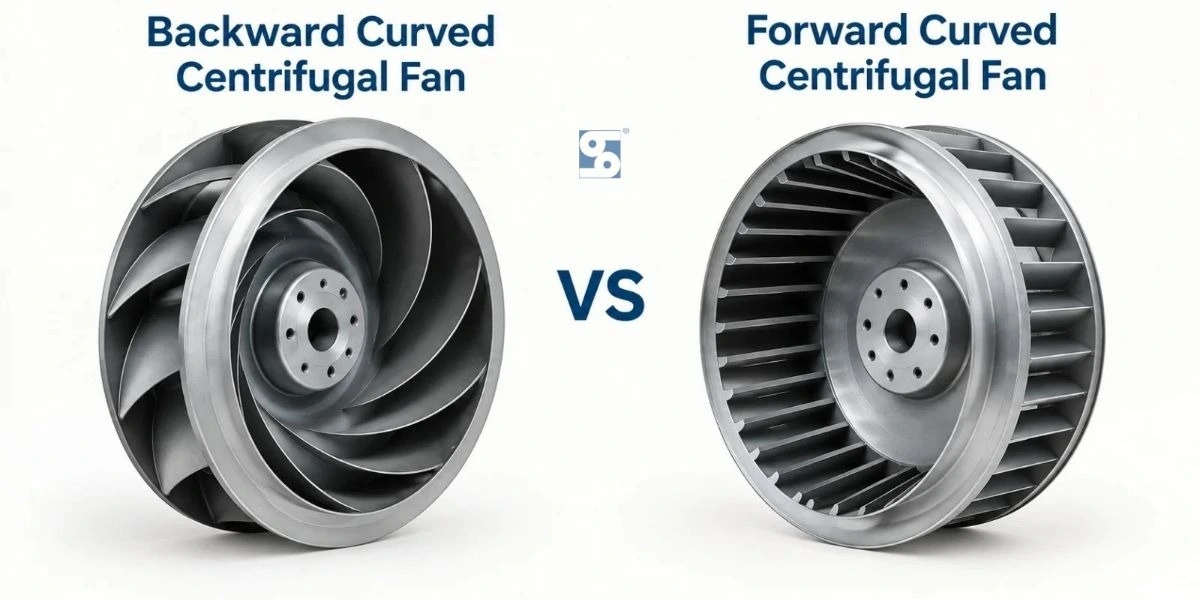
Backward curved blades lean opposite to the direction of rotation. Forward curved blades lean toward the direction of rotation.
This difference affects pressure generation, efficiency, speed, power requirements, and airflow behavior.
Therefore, Backward vs Forward Curved Centrifugal Fans is an important consideration during industrial fan selection.
Understanding Backward Curved Fans
Backward curved fans use blades that curve away from the direction of rotation. This design supports efficient energy transfer and strong pressure performance.
These fans are well suited to applications with higher static pressure requirements. They also work effectively in systems that operate for long periods.
Common applications include:
- Industrial ventilation
- Process exhaust
- Dust collection
- Air handling
- Filtration systems
- Combustion air
- Factory ventilation
Backward curved designs can provide strong efficiency when the fan operates near its intended duty point.
This makes them a practical choice for industrial systems where energy consumption and continuous operation matter.
Understanding Forward Curved Fans
Forward curved fans use blades that curve in the direction of rotation. This design allows the fan to produce high airflow from a compact impeller.
These fans can operate at lower speeds in suitable applications. Their compact configuration can also help where installation space is limited.
Forward curved fans are commonly used in HVAC and general air-handling systems. They can also suit ventilation applications with moderate pressure requirements.
However, the compact design does not automatically make a forward curved fan the better option.
The fan still needs to match the required airflow and static pressure. A mismatch can reduce performance and increase operating costs.
Backward vs Forward Curved Centrifugal Fans Performance
Performance differences become clearer when you compare the two designs at the required operating point.
Backward curved fans generally provide higher efficiency and strong pressure capability. They suit many demanding industrial applications.
Forward curved fans focus on high airflow from a compact design. They work well when the system pressure remains within their suitable operating range.
The actual duty point remains the most important factor.
A fan should deliver the required airflow at the required static pressure. Maximum airflow alone does not provide enough information for correct selection.
When evaluating Backward vs Forward Curved Centrifugal Fans, review the fan curve with the system curve.
The intersection of these curves identifies the expected operating point. This helps engineers select a fan that performs correctly under actual system resistance.
Static Pressure Drives Fan Selection
Every ventilation and air-handling system creates resistance.
Ducts, filters, dampers, bends, coils, silencers, and other components create pressure losses. The fan must overcome these losses while maintaining the required airflow.
Backward curved fans often provide a strong solution for systems with higher static pressure requirements.
Forward curved fans can perform effectively in systems with suitable pressure demands.
Consider a process exhaust system with long ductwork and filtration. The system creates significant resistance. The selected fan needs enough pressure capability to overcome that resistance.
A compact HVAC system may have a different resistance profile. It may require a fan with different performance characteristics.
This is why fan selection should begin with the complete system.
Energy Efficiency Affects Operating Cost
Industrial fans can operate for thousands of hours. Even a small difference in efficiency can affect long-term energy costs.
Backward curved designs generally offer strong efficiency. This makes them attractive for continuous-duty industrial applications.
Forward curved fans can also provide efficient operation when properly matched to the system.
The lowest purchase price does not always mean the lowest total cost.
A fan should provide the required airflow and pressure without unnecessary power consumption. Correct sizing also prevents the motor from working harder than necessary.
When comparing Backward vs Forward Curved Centrifugal Fans, consider both purchase cost and lifecycle operating cost.
This approach provides a more practical view of fan value.
Fan Speed and Noise Matter
Fan speed can influence noise, vibration, energy use, and component life.
Forward curved fans can operate at lower speeds in suitable applications. This can support quieter operation.
Backward curved fans can also provide efficient airflow and controlled operation. However, actual noise depends on the complete fan and installation.
Duct design also affects sound. Poor duct sizing can increase turbulence and noise.
Proper installation, vibration control, balancing, and alignment further improve operating conditions.
The fan should therefore be selected as part of the complete air movement system.
Industrial Applications Need the Right Construction
Industrial fans often handle more demanding air conditions than standard HVAC systems.
The air may contain dust, particles, moisture, heat, fumes, or corrosive substances. Some processes also require continuous operation.
The fan construction must match these conditions.
Material selection is important. Impeller construction is important. Shaft, bearings, motor, housing, and protective features also affect reliability.
A fan designed for clean air may not be suitable for a high-temperature process or dust-loaded application.
Application-specific engineering helps ensure the fan matches the actual operating environment.
This is where working with an experienced Centrifugal Blower Fan Manufacturer in India provides an advantage.
Maintenance Supports Reliable Performance
Fan reliability depends on both design and maintenance.
The impeller needs proper balance. The shaft needs correct alignment. Bearings require regular inspection. The motor also needs appropriate maintenance.
Unusual vibration can indicate imbalance, misalignment, bearing wear, or another mechanical issue.
Early inspection can prevent minor problems from becoming major failures.
Both backward curved and forward curved fans can provide reliable service when they are correctly selected, installed, and maintained.
For industrial facilities, maintenance access should also form part of the original fan selection process.
Backward vs Forward Curved Centrifugal Fans Comparison
The following table provides a practical comparison.
| Factor | Backward Curved Fans | Forward Curved Fans |
| Blade direction | Away from rotation | Toward rotation |
| Efficiency | Generally higher | Suitable within the design range |
| Pressure capability | Strong | Moderate |
| Airflow | High and controlled | High from a compact design |
| Typical applications | Industrial and process systems | HVAC and air handling |
| Operating speed | Often higher | Often lower |
| Space | Depends on system design | Often compact |
| Continuous operation | Well suited | Suitable when correctly selected |
| Energy performance | Strong potential | Good within suitable conditions |
The table shows that neither design works best for every application.
The correct choice depends on the system duty.
Which Fan Fits Your Application
A backward curved fan is a strong choice when the system requires:
- Higher static pressure
- Strong efficiency
- Continuous operation
- Stable airflow
- Demanding industrial service
- Better long-term energy performance
A forward curved fan is suitable when the application requires:
- High airflow from a compact design
- Lower-speed operation
- Moderate pressure
- Space-efficient installation
- HVAC or general air handling
The Backward vs Forward Curved Centrifugal Fans selection should always follow the actual application requirements.
Start with the required airflow and static pressure. Then evaluate temperature, air density, operating hours, air quality, installation space, noise, motor power, and maintenance requirements.
Why Fan Sizing Matters
Correct fan sizing prevents many performance problems.
An undersized fan may fail to deliver the required airflow. An oversized fan can consume unnecessary energy and may operate away from its ideal duty point.
The fan curve provides important information about expected performance.
The selected motor also needs to match the fan’s power requirement. Proper motor sizing supports efficient and reliable operation.
A complete engineering review helps prevent:
- Low airflow
- Excessive power consumption
- Unstable operation
- High vibration
- Premature component wear
- Unnecessary operating costs
This makes professional fan selection an important part of any industrial ventilation project.
Selecting the Right Industrial Fan
The Backward vs Forward Curved Centrifugal Fans decision should not rely on blade design alone.
The application determines the required fan characteristics.
A demanding process system may benefit from the pressure and efficiency of a backward curved design. A compact air-handling system may benefit from the airflow characteristics of a forward curved design.
The right selection delivers the required airflow at the required pressure. It also supports efficient operation and dependable service.
Working with an experienced manufacturer can simplify this process. The manufacturer can evaluate operating conditions and recommend a suitable fan configuration.
Get the Right Fan for Your Application
The Backward vs Forward Curved Centrifugal Fans comparison becomes easier when you start with the actual system requirements.
Backward curved fans offer strong efficiency and pressure performance for many industrial applications. Forward curved fans provide compact airflow solutions for suitable HVAC and air-handling systems.
Neither design is universally better. The right fan is the one that matches the system duty, operating environment, and performance requirements.
For industrial ventilation, process exhaust, dust collection, air handling, and other demanding applications, proper fan selection can improve system performance and control long-term operating costs.
The Blowerfab delivers industrial fan solutions designed around application requirements, airflow targets, pressure needs, and reliable operation. As an Industrial Fans manufacturer in Gujarat, the company supports industrial requirements with application-focused fan solutions.
Contact The Blowerfab today with your airflow, static pressure, temperature, and application details to discuss the right centrifugal fan solution for your system.