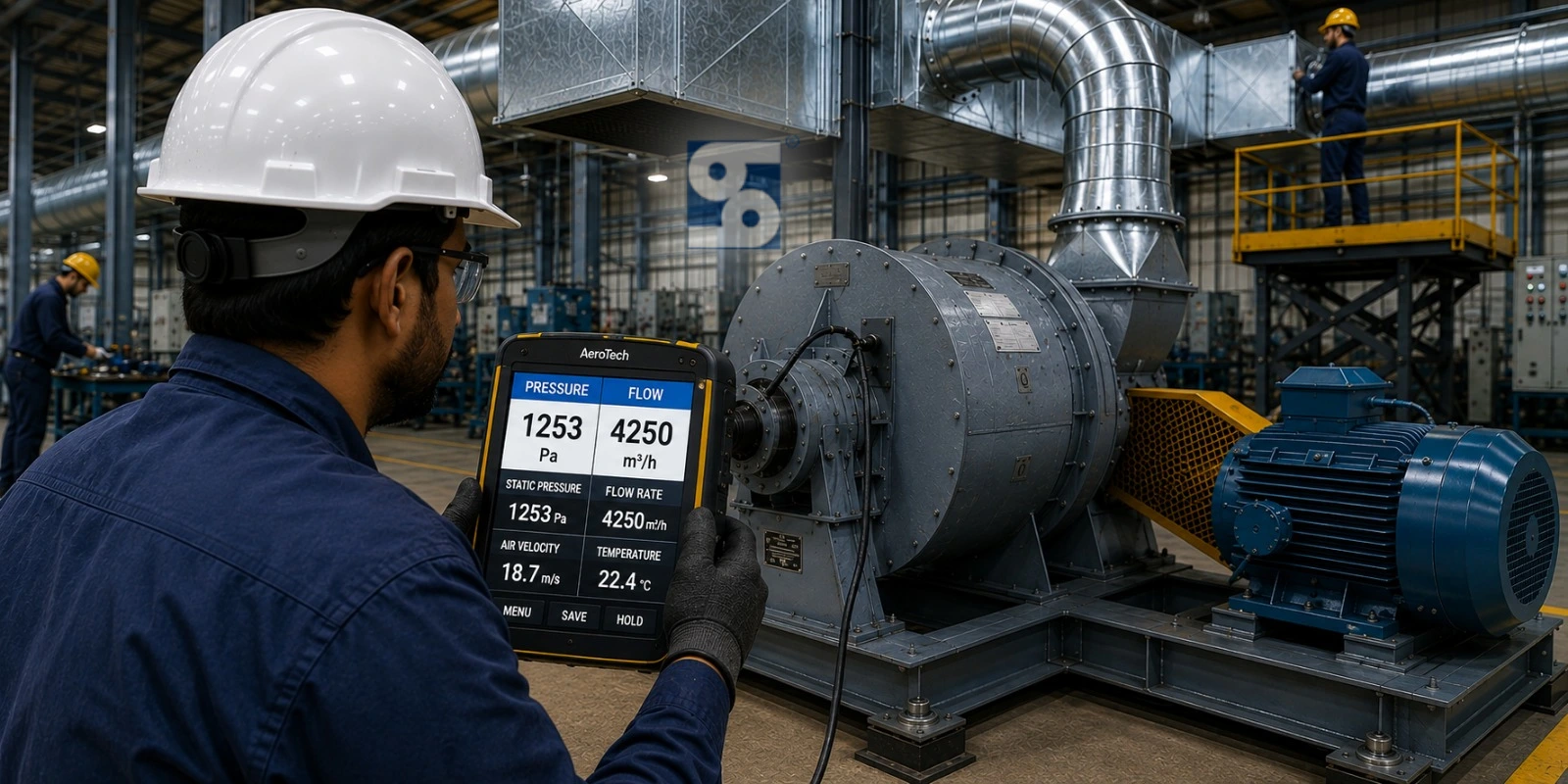
Industrial ventilation plays a vital role in maintaining safe, productive, and energy-efficient industrial facilities. Every ventilation system depends on balanced airflow to remove heat, fumes, dust, smoke, and airborne contaminants.
However, airflow alone does not determine system performance. Static pressure is another critical factor that directly affects how efficiently a fan or blower operates.
Many facilities experience poor airflow, excessive energy use, or repeated equipment failures because static pressure is not measured or calculated correctly. Even a high-quality fan cannot perform well if the system resistance exceeds its operating range.
This article explains how to calculate static pressure in an industrial ventilation system, what influences it, and why it matters when selecting industrial blowers and fans.
Industry guidelines such as the AMCA standards for industrial fans and blowers also help engineers evaluate fan performance and pressure requirements when designing efficient ventilation systems.
What Is Static Pressure
Static pressure is the resistance that air faces while moving through an industrial ventilation system. This resistance comes from ducts, bends, filters, dampers, hoods, silencers, and other system components.
A fan must generate enough pressure to overcome this resistance and maintain the required airflow. If static pressure is too high, airflow decreases. If it is too low, the system may not deliver the required air volume to critical areas.
Proper static pressure calculation helps maintain stable airflow, improve energy efficiency, and reduce unnecessary wear on equipment.
Why Static Pressure Matters in Industrial Ventilation
Every industrial ventilation system is designed to move a specific amount of air. Static pressure determines how hard the fan works to deliver that airflow.
Accurate pressure calculations help facilities:
- Improve airflow performance
- Reduce energy consumption
- Select the correct industrial blower
- Increase equipment life
- Maintain safe working conditions
- Reduce maintenance costs
- Improve overall process efficiency
Incorrect pressure values often result in oversized or undersized fans, leading to poor system performance.
Many industries also focus on the Consequences of Industrial Fan in Pollution Control when evaluating system efficiency because poor pressure balance directly impacts emission control performance.
Components That Create Static Pressure
Every part of an industrial ventilation system adds some resistance to airflow.
The most common sources include:
- Straight duct sections
- Elbows and bends
- Branch connections
- Air filters
- Dampers
- Louvers
- Air handling units
- Dust collectors
- Cyclones
- Heat exchangers
- Exhaust hoods
- Silencers
The longer and more complex the duct network becomes, the higher the total static pressure.
This is why system layout plays an important role during ventilation design.
Units Used for Static Pressure
Static pressure is generally measured in:
- Inches of Water Gauge (in. WG)
- Millimeters of Water Gauge (mmWG)
- Pascals (Pa)
Industrial fan manufacturers normally specify fan performance using airflow and static pressure together on performance curves.
These values help engineers compare operating conditions with actual system requirements.
Formula to Calculate Static Pressure
The basic calculation is straightforward.
Total Static Pressure = Sum of Pressure Losses Across the Entire System
Pressure losses include every component that air passes through before reaching the discharge point.
For example:
- Duct friction = 1.8 in. WG
- Air filter = 0.7 in. WG
- Two elbows = 0.6 in. WG
- Damper = 0.5 in. WG
- Dust collector = 2.4 in. WG
Total Static Pressure = 1.8 + 0.7 + 0.6 + 0.5 + 2.4 = 6.0 in. WG
The selected fan should deliver the required airflow at approximately 6.0 inches of water gauge.
This approach helps maintain reliable industrial ventilation throughout the system.
How to Measure Static Pressure
Many facilities verify system pressure using a manometer or differential pressure gauge.
Measurements are usually taken before and after major equipment such as filters, dust collectors, or duct sections.
The measured pressure values are then compared with the original design calculations.
Large differences often indicate:
- Dirty filters
- Blocked ducts
- Air leakage
- Damaged dampers
- Improper balancing
- Fan performance issues
Routine monitoring helps identify problems before they affect production.
Factors That Increase Static Pressure
Several conditions increase resistance inside an industrial ventilation system.
These include:
Long Duct Runs
Longer ducts create more friction, increasing pressure loss.
Multiple Bends
Each elbow changes airflow direction and creates turbulence.
Dirty Filters
As filters collect dust, airflow resistance gradually increases.
Small Duct Size
Undersized ducts force air to move faster, creating additional friction.
Dampers
Partially closed dampers increase resistance throughout the system.
Dust Collection Equipment
Bag filters, cyclones, and scrubbers naturally create pressure loss during operation.
Each component should be included during pressure calculations to avoid selecting the wrong blower.
Common Mistakes During Static Pressure Calculation
Many ventilation systems lose efficiency because of incorrect assumptions during design.
Some common mistakes include:
- Ignoring pressure losses from fittings
- Excluding filters or silencers
- Using incorrect duct dimensions
- Not considering future filter loading
- Selecting fans using airflow only
- Assuming every duct section has identical resistance
These mistakes often reduce the effectiveness of industrial ventilation and increase operating costs.
Static Pressure and Fan Selection
Static pressure directly affects fan selection.
Industrial fan performance curves always show airflow against static pressure.
If the calculated pressure is higher than the fan rating, airflow drops significantly.
If pressure is lower than expected, the fan may operate away from its best efficiency point.
This is one reason why Industrial Fans Transform Ventilation in Factories when they are matched correctly with actual system resistance instead of estimated values.
Proper selection improves both airflow stability and equipment reliability.
Why System Layout Matters
Pressure calculations become much more accurate when the ventilation layout is optimized.
Good duct routing minimises unnecessary resistance.
Smooth transitions, proper duct sizing, and balanced airflow reduce pressure losses throughout the system.
This is also why Proper Fan Placement Improves Industrial Ventilation Performance. Fan location influences airflow distribution, pressure balance, and long-term operating efficiency.
Well-planned layouts reduce energy use without compromising airflow.
Standard and Custom Systems
Every facility has different airflow requirements.
Some applications operate with short duct systems and low pressure. Others require long duct networks with multiple filtration stages.
In these situations, comparing Custom Built vs Standard Industrial Fans helps engineers determine which solution better matches the required airflow and static pressure.
Selecting equipment based on actual operating conditions usually delivers better long-term performance.
Industry Applications
Static pressure calculations are essential across many industries.
For example, pharmaceutical facilities require highly controlled airflow because cleanroom performance depends heavily on accurate pressure management.
Similarly, large public infrastructure projects demonstrate how Industrial Fans for Airports, Metros, and Building Ventilation maintain consistent airflow while handling complex duct systems and varying operating conditions.
Regardless of the application, accurate pressure calculations remain a fundamental part of successful industrial ventilation.
Choosing the Right Industrial Blower
Static pressure and airflow should always be evaluated together.
Different blower designs perform better under different pressure ranges.
Backward-curved centrifugal fans, radial blowers, axial fans, and high-pressure blowers all serve different applications.
Facilities comparing different Industrial Blowers Types should evaluate airflow, efficiency, operating environment, maintenance requirements, and required static pressure before making a final selection.
A balanced approach helps improve system reliability while reducing long-term operating costs.
Optimizing Industrial Ventilation Performance
Static pressure is one of the most important factors in any industrial ventilation system. Accurate calculations help maintain proper airflow, improve energy efficiency, reduce maintenance, and extend equipment life. Every duct, filter, bend, and system component contributes to total resistance, making detailed pressure calculations essential during system design and equipment selection.
A well-designed industrial ventilation system delivers consistent performance because airflow and static pressure remain properly balanced. When facilities calculate pressure accurately and match it with the right fan characteristics, they achieve better operational efficiency and long-term reliability.
Whether you are designing a new system or upgrading an existing one, selecting the right blower begins with accurate static pressure calculations.
If you need guidance on choosing the right solution for your application, Blowerfab offers over 27 years of expertise in industrial blower manufacturing.