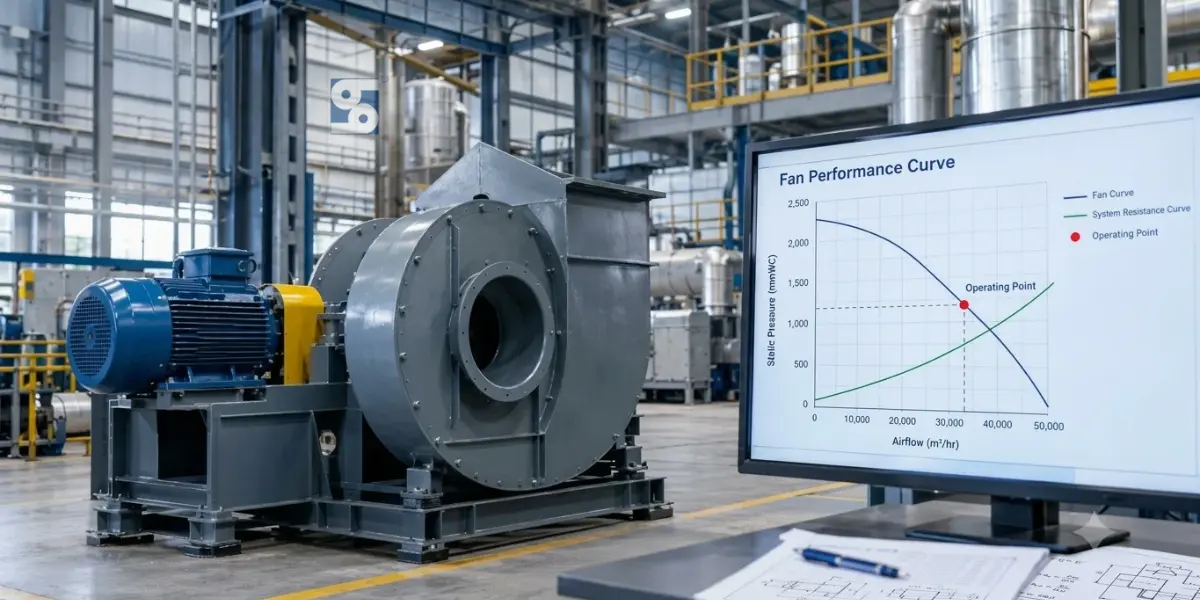
Selecting an industrial fan requires more than checking its maximum airflow or motor power. The fan must deliver the required airflow at the system’s operating pressure. Otherwise, it may struggle to maintain performance, consume excess energy, or fail to meet process requirements.
An Industrial Fan Performance Curve helps you understand how a fan performs under different operating conditions. It shows the relationship between airflow, pressure, power consumption, and efficiency. These parameters help you compare industrial fan designs and select a model that matches your application.
For industrial ventilation, cooling, dust collection, and process air movement, start with accurate system requirements. Understanding the performance curve helps you evaluate suitable models before purchasing an industrial fan or blower.
What Is an Industrial Fan Performance Curve
An Industrial Fan Performance Curve is a graph that shows how a fan’s airflow changes with pressure at a specified rotational speed and configuration. Manufacturers develop these curves through testing under defined conditions.
The graph helps you determine whether a fan can deliver the required airflow while overcoming system resistance. Depending on the manufacturer’s data, it may also show power consumption, efficiency, and the fan’s recommended operating range.
Manufacturers may provide separate curves for static pressure, total pressure, power, and efficiency. These curves help you assess operating conditions and compare suitable fan models.
For example, an industrial centrifugal fan may suit applications that require higher pressure to move air through ducts, filters, or process equipment. An axial fan may suit applications that require high airflow at relatively low system resistance. The actual choice depends on the operating conditions and the fan’s performance data.
Why Fan Performance Matters for Industrial Applications
Choosing a fan based only on its maximum airflow can lead to poor performance. Once connected to a complete system, the fan must overcome resistance from ducts, filters, bends, and other components. This resistance affects the airflow the fan can deliver.
The Industrial Fan Performance Curve helps you evaluate how the fan performs under these actual operating conditions.
- Airflow requirements help maintain ventilation, cooling, and process performance.
- Pressure requirements determine whether the fan can overcome resistance from ducts, filters, bends, and connected equipment.
- Power consumption helps you estimate operating costs and select a suitable motor.
- Fan efficiency helps you compare energy performance at the required operating point.
- Operating limits help you avoid conditions that may affect stability, noise, or reliability.
A correctly selected fan supports consistent airflow and helps control energy costs. It also reduces the risk of purchasing a model that cannot meet your system requirements.
Key Parameters to Check on the Performance Curve
Before comparing fan models, understand the main parameters shown on the graph.
Airflow Rate
Airflow measures the volume of air a fan moves over a specific period. Manufacturers commonly express airflow in cubic feet per minute (CFM) or cubic meters per hour (m³/h).
Your application determines the required airflow. An industrial ventilation system may need to remove heat, while a dust collection system must move enough air to capture and transport dust effectively.
Check the airflow at the required operating pressure. A fan’s maximum airflow rating does not guarantee it will deliver the same volume after installation.
Static Pressure and Total Pressure
Pressure indicates the resistance the fan must overcome to move air through a system.
Industrial fan static pressure helps you evaluate the pressure required to overcome system resistance. Static pressure measures the pressure component associated with the system, while total pressure includes both static pressure and velocity pressure.
Duct length, bends, filters, dampers, and connected machinery all contribute to system resistance. A suitable industrial blower fan must overcome this resistance while maintaining the required airflow.
Always compare the system requirement with the correct pressure curve. Static pressure and total pressure are different measurements, so you should not treat them as interchangeable.
Fan Power Consumption
The power curve shows how much power the fan requires at different operating points. Manufacturers may specify shaft power or brake horsepower (BHP).
The motor must handle the fan’s expected power demand under the specified operating conditions. Also consider drive losses and the manufacturer’s motor recommendations.
Reviewing power requirements helps you avoid motor overload and estimate the energy needed to run the fan. This is especially important for industrial facilities that operate fans for long hours.
Fan Efficiency and Best Efficiency Point
The efficiency curve shows how effectively the fan converts input power into useful airflow and pressure.
The best efficiency point (BEP) identifies the operating condition where the fan achieves its highest efficiency under the stated test conditions.
Operating near the BEP can support efficient and stable performance. However, the selected fan must also meet your airflow, pressure, and process requirements. Do not select a fan based on its peak efficiency alone.
How to Analyze an Industrial Fan Performance Curve
Follow these steps to compare fan performance with your actual application.
Determine the Required Airflow and Pressure
Start by identifying the airflow your process needs. Then calculate the system pressure required to deliver that airflow.
Include resistance from ducts, bends, dampers, filters, and connected equipment. If filters become more restrictive as they collect dust, consider the expected change in pressure during operation.
Accurate calculations help you avoid selecting a fan that is too small or unnecessarily large.
Locate the Operating Point
Find the required airflow on the horizontal axis and the corresponding pressure on the vertical axis. Use these values to identify your target operating point.
Next, check whether the fan curve passes through the required point.
The actual operating point occurs where the fan performance curve intersects the system resistance curve. This intersection represents the airflow and pressure the fan and system produce together at a given speed and configuration.
For example, suppose your application requires 5,000 CFM at 4 inches of water gauge (in. w.g.) of static pressure. Check whether the selected fan can deliver approximately 5,000 CFM at that pressure under the specified test conditions. A fan that delivers 5,000 CFM only at a much lower pressure may not meet your requirements.
This comparison helps you narrow down suitable fan models before making a purchase.
Check the Efficiency at the Operating Point
Once you identify the operating point, review the efficiency curve.
Compare how efficiently different models deliver the required airflow and pressure. A fan with a higher maximum efficiency may not perform as efficiently at your actual operating point.
Choose a model that combines suitable efficiency with reliable operation and the required process performance.
Verify Motor Power and Operating Limits
Check the power curve at the expected operating point. Confirm that the recommended motor can handle the load.
Also review the fan’s operating range, rotational speed, temperature limits, and installation conditions. Air density and altitude can affect fan performance, so use data that matches your application.
These checks help prevent motor overload and reduce the risk of operating the fan outside its recommended range.
Compare Suitable Fan Models
Use the Industrial Fan Performance Curve to compare multiple models against the same requirements.
Review airflow, pressure, efficiency, power demand, fan speed, and operating limits. Also consider the available installation space and maintenance requirements.
An industrial centrifugal fan may suit a high-resistance system, while another fan design may better suit a different airflow requirement.
Refer to the U.S. Department of Energy’s guidance on fan systems to understand how fan selection affects energy use and overall system performance. Select the model based on the complete system rather than one performance figure.
Common Fan Selection Mistakes to Avoid
Even a detailed performance curve can lead to the wrong choice if you overlook important factors.
- Choosing by maximum airflow alone ignores the pressure required to move air through the system.
- Ignoring system resistance can cause the fan to deliver less airflow than expected.
- Overlooking motor power may lead to an unsuitable motor or higher operating costs.
- Focusing only on peak efficiency can result in a fan that performs poorly at the required operating point.
- Using the wrong performance curve can lead to inaccurate comparisons if the fan speed, configuration, or test conditions differ.
- Ignoring operating conditions can affect performance when air temperature, density, or installation conditions change.
Check these factors before finalizing your fan selection. A careful review helps you choose a fan that meets your process requirements and supports dependable operation.
Select the Right Industrial Fan for Reliable Performance
Choosing the right industrial fan requires evaluating airflow, pressure, power consumption, and operating conditions. An Industrial Fan Performance Curve provides the technical information needed to compare models and identify a fan that meets your system requirements.
Before selecting a fan, evaluate your application, operating conditions, pressure requirements, and power needs. The right selection helps maintain consistent performance and control operating costs.
Looking for an Industrial Fan or Blower That Meets Your Requirements?
Choose Blowerfab for industrial fan and blower solutions tailored to your application needs. Share your required airflow, operating pressure, and process details to discuss suitable fan options.
Contact Blowerfab to discuss your requirements and request a quotation for your industrial fan or blower.