Introduction
Industrial fans play a critical role in manufacturing plants, process industries, power plants,
warehouses, and ventilation systems. Their performance directly affects productivity, energy
consumption, air quality, and operational safety. However, selecting a fan based only on catalog
data can create problems. Many industries face performance gaps after installation because the
actual output differs from the claimed specifications.
This is where AMCA standards become important.
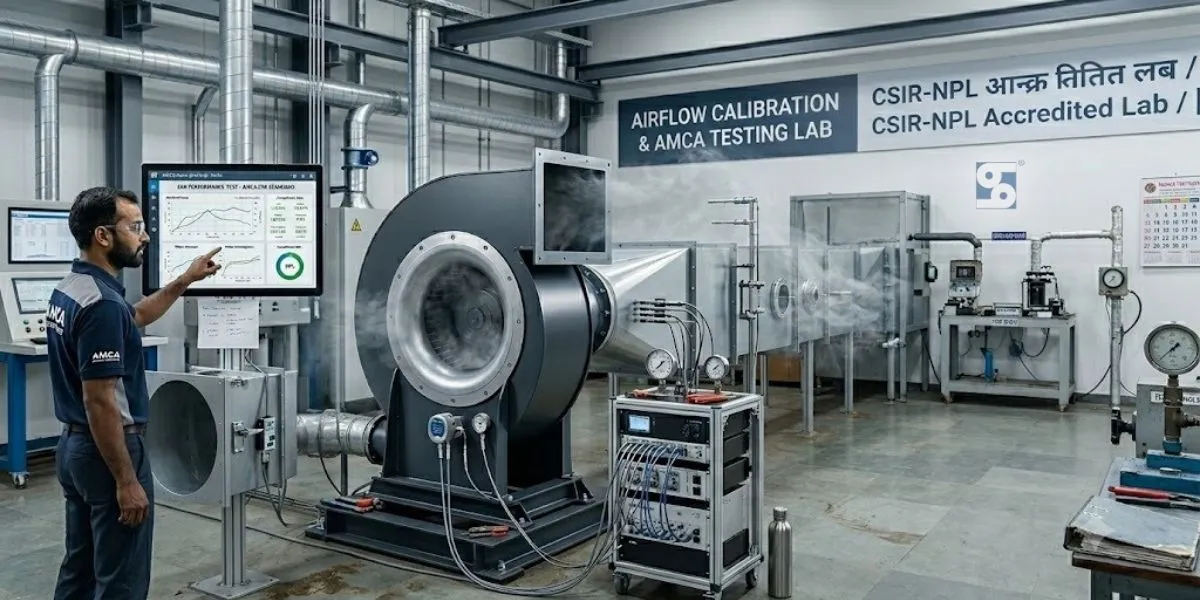
AMCA standards provide a reliable method for testing and verifying industrial fan performance. They
help manufacturers, consultants, contractors, and plant owners compare products on a common
platform. The result is greater transparency, better efficiency, and improved confidence during
fan selection.
Why Performance Testing Matters
Industrial facilities depend on accurate airflow and pressure levels. Even a small deviation can
affect an entire process.
Many industries experience common challenges:
Lower airflow than expected
Higher energy consumption
Excessive vibration
Increased noise levels
Reduced equipment life
Poor ventilation performance
Without standardized testing, it becomes difficult to determine whether a fan can deliver its
promised performance. Proper industrial fan selection can significantly reduce these risks.
A fan may appear efficient on paper. Yet actual operating conditions can tell a different story.
This creates operational risks and unnecessary expenses.
Performance testing helps eliminate these uncertainties.
Understanding AMCA Standards
AMCA stands for the Air Movement and Control Association International. It is a global AA A
recognized organization that develops standards for air movement equipment.
The association establishes testing procedures for:
Airflow measurement
Static pressure
Fan efficiency
Sound performance
Energy ratings
Air movement systems
These standards ensure that manufacturers test products such as centrifugal fans and axial fans
using consistent methods.
As a result, buyers can compare different products with confidence.
Instead of relying on marketing claims, industries can evaluate certified performance data.
Key AMCA Standards Used for Industrial Fans
Several AMCA standards apply to industrial fan testing. Each standard focuses on a specific
performance parameter.
AMCA Standard 210
This is one of the most widely used fan testing standards.
It defines laboratory methods for testing aerodynamic performance.
The standard measures:
Airflow volume
Fan pressure
Fan power
Mechanical efficiency
Manufacturers use this standard to generate performance curves that engineers use during fan
selection.
AMCA Standard 300
Noise control has become a major concern in industrial environments.
AMCA 300 establishes procedures for sound testing.
The standard evaluates:
Sound power levels
Acoustic performance
Noise characteristics
This information helps industries comply with workplace safety requirements and environmental regulations
regulations.
AMCA Standard 211
This standard focuses on certified fan performance ratings.
It verifies whether published fan data matches actual test results.
Buyers gain confidence because the performance claims undergo independent validation.
AMCA Standard 205
Energy efficiency is a growing priority across industries.
AMCA 205 introduces the Fan Energy Index.
The index allows users to compare energy performance among different fan designs.
Higher efficiency means lower operating costs and reduced energy consumption.
How AMCA Testing Benefits Industrial Users
Many industries view industrial fans as simple equipment. In reality, fans consume significant
amounts of energy throughout their service life.
A low-cost fan can become expensive if it operates inefficiently.
AMCA-tested fans help users avoid this issue.
Accurate Performance Data
Verified testing provides reliable airflow and pressure information.
Engineers can design systems with greater precision.
This reduces the risk of underperformance after installation.
Better Energy Efficiency
Energy costs continue to rise.
An efficient fan consumes less power while delivering the required airflow.
This reduces operating expenses over the long term.
Improved System Reliability
A properly selected fan experiences less stress during operation.
This leads to:
Reduced breakdowns
Lower maintenance costs
Longer service life
Easier Product Comparison
Without a common testing standard, comparing products becomes difficult.
AMCA certification creates a level playing field.
Users can compare multiple manufacturers using identical performance criteria.
Regulatory Compliance
Many projects require compliance with environmental and workplace standards.
AMCA-tested equipment supports these requirements through documented performance data.
AMCA Standards and Industrial Environments
Different industries operate under different conditions.
A pharmaceutical plant has different ventilation requirements than a cement plant.
Similarly, a chemical processing facility faces different challenges than a textile manufacturing
unit.
AMCA standards help ensure consistent fan performance across various environments.
These include:
Cement plants
Steel industries
Chemical processing units
Food processing facilities
Pharmaceutical plants
Power generation plants
Warehouses
Pollution control systems
Each application demands accurate airflow and pressure characteristics. Standardized testing
helps achieve these requirements.
Limitations of Non-Tested Fans
Many low-cost alternatives enter the market with unverified performance claims.
At first glance, these products may appear attractive.
However, industries often face hidden problems.
Common limitations include:
Inaccurate airflow ratings
Poor energy efficiency
Excessive noise
Higher maintenance costs
Reduced reliability
Inconsistent performance
The initial savings often disappear through higher operating expenses.
This is why performance validation has become increasingly important during equipment
selection.
Industry Comparison: AMCA-Tested vs Non-Tested Fans
When evaluating equipment, companies should also consider the key factors to consider before
buying industrial fans.
AMCA-tested fans generally offer:
Verified performance data
Consistent airflow delivery
Better energy efficiency
Predictable operating costs
Greater engineering confidence
Non-tested alternatives may offer lower purchase prices but often carry higher operational risks.
Most consultants and industrial project teams now prefer tested and validated performance data
before finalizing equipment.
Why Manufacturers Follow AMCA Standards
Leading industrial fan manufacturers understand that customers need more than equipment.
They need confidence.
Testing according to recognized standards demonstrates a commitment to quality and
engineering excellence.
Manufacturers that invest in performance testing often focus on:
Product reliability
Design optimization
Energy efficiency
Long-term customer satisfaction
This approach creates stronger trust between suppliers and industrial users.
Blowerfab’s Approach to Performance and Reliability
Industrial applications demand more than standard airflow solutions. They require equipment
designed for specific operating conditions.
Blowerfab has built its reputation by providing customized industrial fans, centrifugal blowers,
axial flow fans, ventilation systems, and air movement solutions for diverse industries. The
company focuses on engineering-driven solutions, performance reliability, and application-
specific designs backed by decades of manufacturing experience.
By emphasizing quality manufacturing, technical expertise, and customer-focused engineering,
Blowerfab helps industries achieve efficient, dependable air-movement performance.
Building Confidence Through Verified Fan Performance
AMCA standards serve as an essential benchmark for industrial fan performance testing. They provide a structured and reliable method to measure airflow, pressure, efficiency, and noise characteristics.
For plant owners, consultants, and engineers, these standards reduce uncertainty during equipment selection. They improve performance predictability, support energy efficiency goals, and help lower long-term operating costs.
As industrial processes become more demanding, choosing fans backed by recognized testing standards becomes increasingly important. Verified performance data allows businesses to make informed decisions and build reliable ventilation and air movement systems.
Blowerfab recognizes the importance of adhering to industry-recognized performance standards, helping customers evaluate fan performance with greater confidence and transparency.
Investing in properly tested industrial fans is not simply about meeting specifications. It is about ensuring efficiency, reliability, and long-term operational success.