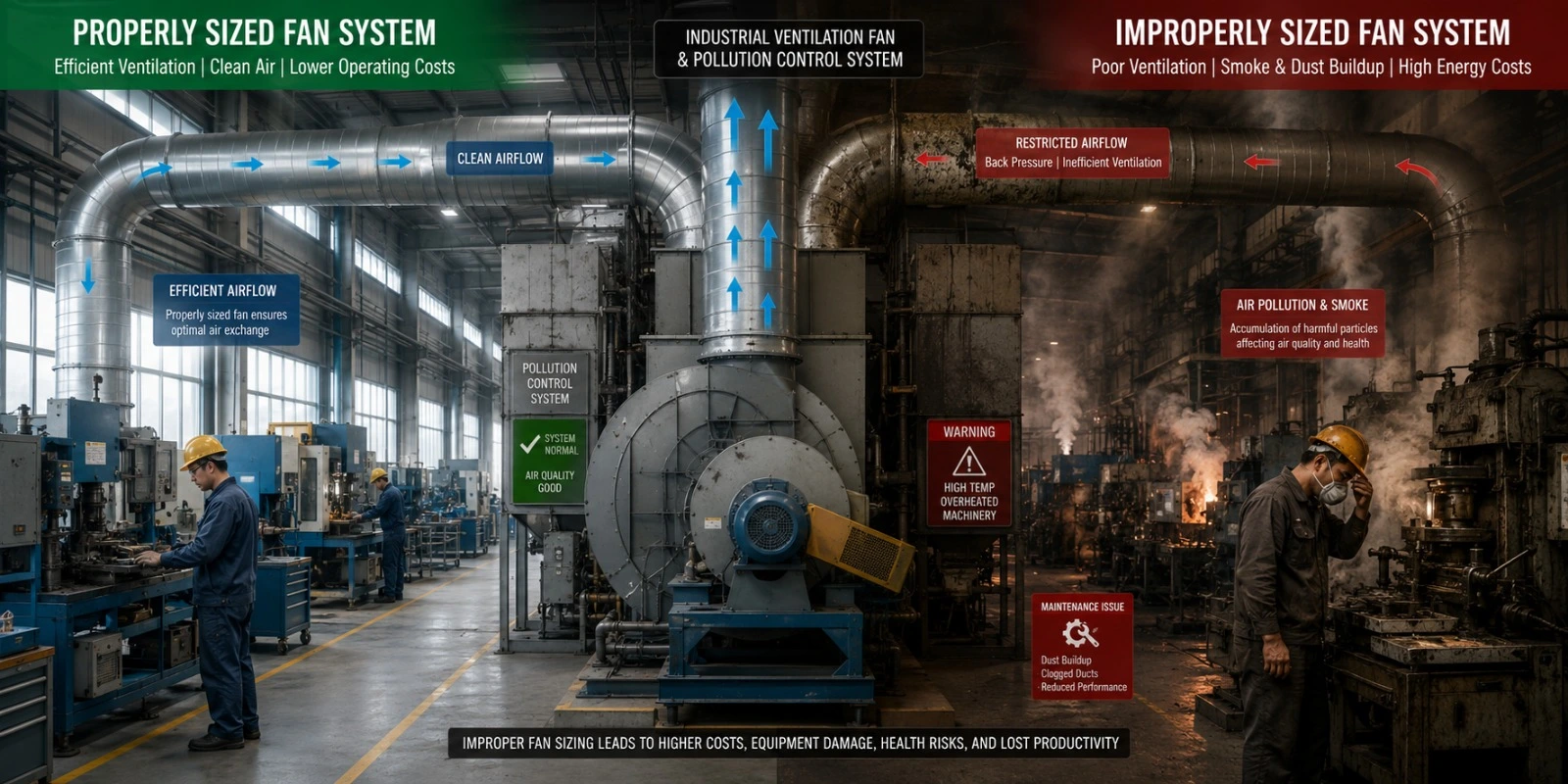
Industrial systems rely on airflow. In pollution control and ventilation systems, airflow keeps operations safe, stable, and efficient.
“At the centre of this process sits the Industrial Fan. Modern facilities rely on efficient Heavy Duty Industrial Blower Fans to maintain stable airflow and pollution control performance.
Yet many facilities overlook one important factor. They chose the wrong fan size.
An oversized or undersized Industrial Fan creates more than airflow issues. It affects energy use, equipment life, worker safety, and environmental performance.
Over time, these problems increase operational costs and reduce system reliability.
Why Industrial Fan Sizing Matters
Every industrial setup has unique airflow requirements. A fan must match the exact system demand. This includes air volume, pressure, temperature, duct resistance, and filtration load.
When an Industrial Fan operates outside its intended range, the entire system suffers. The airflow becomes unstable. Equipment experiences stress. Energy usage rises. In some cases, the system fails to meet environmental standards.
Several operational conditions influence airflow stability, and understanding the Top Factors That Affect Industrial Fan Performance helps industries improve system efficiency and reliability.
Proper fan sizing supports balanced performance. It also helps facilities maintain operational consistency and long-term efficiency.
1. Higher Energy Consumption
One of the first consequences of improper fan sizing is excessive energy use.
An oversized Industrial Fan pushes more air than the system requires. This creates unnecessary power consumption. The motor works harder, even when the process does not demand high airflow.
An undersized fan also wastes energy. It struggles to maintain airflow levels. As a result, the system operates longer to achieve the same outcome.
Industrial ventilation systems often run continuously. Even a small sizing error can increase electricity costs over time. In large facilities, this issue becomes significant.
Energy efficiency depends on airflow accuracy. Correct sizing helps maintain stable performance without wasting power.
2. Poor Air Quality and Pollution Control
Pollution control systems depend on consistent airflow. Incorrect fan sizing disrupts this balance.
An undersized Industrial Fan may fail to remove dust, fumes, smoke, or harmful gases effectively. Contaminants remain inside the workspace. This affects indoor air quality and increases health risks for workers.
In pollution control systems, weak airflow also reduces filtration efficiency. Dust collectors and scrubbers cannot perform properly without adequate air movement.
An oversized fan creates a different problem. Excessive airflow may carry particles too quickly through filters. This reduces capture efficiency and increases wear on filtration components.
Air quality regulations continue to become stricter across industries. Improper airflow management may lead to compliance issues and operational disruptions.
A properly sized fan supports cleaner air and more reliable pollution control performance.
3. Increased Equipment Wear and Maintenance
Improper fan sizing places stress on connected equipment.
When airflow remains unstable, system components operate under inconsistent conditions. Motors, bearings, filters, dampers, and ducts experience unnecessary strain.
An oversized Industrial Fan often creates excessive vibration. Over time, this weakens mechanical components and shortens equipment lifespan.
Undersized fans also create wear issues. They operate close to maximum capacity for long periods. This constant load increases heat generation and motor stress.
Maintenance teams then face recurring breakdowns, unplanned downtime, and higher repair costs.
In industrial environments, downtime affects productivity. Delayed operations impact overall efficiency and increase operational pressure.
Correct fan sizing helps maintain smoother operation. It also reduces maintenance frequency and extends equipment life.
4. Unstable System Performance
Ventilation systems require balance. Airflow must remain stable across all sections of the process.
Improper fan sizing disrupts this balance.
An oversized Industrial Fan may create excessive air velocity. This leads to pressure fluctuations inside ducts and filtration systems. Workers may also experience uncomfortable airflow conditions in occupied spaces.
An undersized fan struggles to maintain consistent airflow. Certain areas receive poor ventilation while others remain overloaded.
This instability affects process control. Temperature regulation becomes difficult. Dust extraction performance weakens. Production environments become less predictable.
Many industrial operations depend on controlled environmental conditions. Even minor airflow inconsistencies may affect product quality and operational safety.
Stable airflow improves system reliability. Proper sizing plays a critical role in achieving this stability.
5. Higher Long-Term Operational Costs
Improper fan sizing rarely creates a single isolated issue. Instead, it triggers multiple operational problems at once.
Higher energy use increases utility bills. Frequent maintenance raises service costs. Equipment replacement becomes more common. Air quality issues may lead to regulatory penalties or production interruptions.
These combined expenses create long-term financial pressure.
Many facilities initially choose a fan based on short-term assumptions. Some select larger fans for “extra capacity”. Others choose smaller models to reduce upfront costs.
However, poor sizing often costs more over the life of the system.
A properly selected Industrial Fan supports long-term operational efficiency. It helps maintain balanced airflow while reducing avoidable expenses.
Factors That Influence Proper Fan Sizing
Several technical factors influence fan selection. Engineers and facility managers must evaluate the complete system before choosing a fan.
Important considerations include:
- Required airflow volume
- Static pressure requirements
- Duct layout and resistance
- Filtration system load
- Air temperature and humidity
- Future operational changes
- Noise and vibration control
- Energy efficiency goals
Each factor affects overall fan performance. Ignoring one element may reduce system effectiveness.
Accurate system analysis supports better airflow management and long-term reliability.
Modern facilities increasingly rely on Custom-Built Industrial Fans designed around exact airflow, pressure, and process requirements.
The Role of System Design in Ventilation Efficiency
Fan performance does not depend on the fan alone. The efficiency of the entire ventilation system relies on how well every component works together.
Even when the fan size appears correct, issues such as poor duct design, clogged filters, air leakage, or inaccurate pressure calculations can reduce airflow performance and affect overall system stability.
This is why system-level planning is essential in industrial ventilation and pollution control applications. Engineers carefully evaluate airflow patterns, resistance points, operating pressure, and process requirements before finalising the right fan configuration for a facility.
Today’s industrial environments also demand higher energy efficiency and improved environmental compliance. A properly designed airflow system helps industries achieve both objectives by maintaining consistent ventilation, improving equipment performance, and creating safer working conditions.
Industrial airflow systems require precision. An incorrectly sized fan can lead to excessive energy consumption, poor pollution control, faster equipment wear, unstable operations, and rising maintenance costs over time.
In contrast, the right Industrial Fan supports balanced airflow, improves operational efficiency, reduces downtime, and helps maintain cleaner air across the facility.
As industries continue to modernise, accurate fan sizing and complete system optimisation are becoming increasingly important for long-term operational reliability.
BlowerFab provides customised industrial airflow and ventilation solutions designed to meet specific operational requirements.
From industrial fans and blowers to pollution control and ventilation system support, the company focuses on delivering energy-efficient solutions that improve airflow performance, enhance system reliability, and reduce long-term operational costs.
With expertise in system design and application-specific engineering, Symbiosis Blower by UDCI helps industries build more efficient and dependable airflow systems.