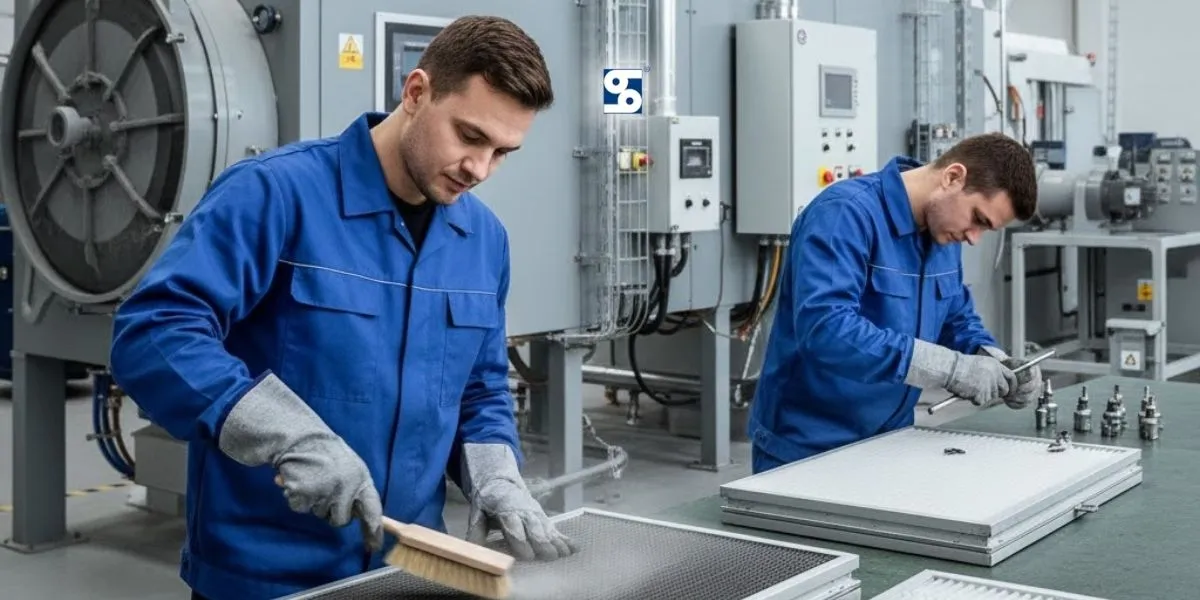
Air washers play a critical role in the machine manufacturing industry. They regulate temperature. They control humidity.
They improve indoor air quality across production floors. Stable air conditions support machine accuracy and workforce comfort.
However, performance does not depend only on system design. It depends on maintenance. In every air washer, Filters and Nozzles perform the most essential functions.
When they remain clean, the system operates smoothly. When they become blocked, efficiency drops quickly.
Regular cleaning of Filters and Nozzles improves airflow, stabilises cooling, and reduces energy consumption. It also protects equipment from avoidable stress.
The Role of Air Washers
Manufacturing facilities operate under demanding conditions. Machines generate heat, and processes release particles.
Continuous production increases the air load. Air washers manage these factors by circulating cooled and filtered air.
Air is drawn through filters by the system. Dust and dirt are captured by filters. Water is evenly sprayed by nozzles to chill and humidify the air.
Modern manufacturing facilities rely on advanced air washer systems designed for consistent cooling and air purification.
These systems use precisely engineered Nozzles to ensure uniform water distribution and effective particle removal.
Industrial air washer solutions also support humidity control, which protects machinery and improves operational stability.
You can learn more about the design, working principles, and industrial applications of an air washer system for industrial processes. It helps to understand how proper maintenance directly improves system efficiency and long-term performance.
How Dirty Filters Restrict Airflow
Filters capture airborne particles every day. Over time, dust builds up. The filter surface becomes dense. Air struggles to pass through.
Fans have to work harder when ventilation is restricted. Motors consume more energy. The efficiency of cooling decreases. Energy costs go up.
Airflow is restored by routinely inspecting and cleaning the filters and nozzles. Air may flow freely through clean filters.
The system gets to the desired temperature more quickly. There is less strain on the components.
In machine manufacturing, precise airflow supports machining accuracy. Excess heat can affect tolerances. Proper filtration prevents dust from settling on sensitive equipment.
The Impact of Clogged Nozzles on Cooling Performance
Water is dispersed via nozzles in a thin spray pattern. This spray enables effective evaporation. It guarantees uniform cooling throughout the air washer chamber.
Mineral deposits and impurities often block nozzle openings. Spray patterns become uneven. Some sections receive excess water. Others receive too little.
This imbalance reduces cooling efficiency. It also increases water consumption and pumps work longer to maintain pressure.
Routine cleaning of Filters and Nozzles removes scaling and restores proper spray distribution.
Even water flow supports consistent evaporation. This improves system response and stabilises environmental conditions.
Energy Efficiency and Cost Control
Energy efficiency remains a top priority in modern manufacturing. Air washers often run for extended hours. Even small inefficiencies increase operational costs.
When Filters and Nozzles remain clean, motors and pumps operate at optimal load. Air moves smoothly, water circulates evenly, and energy usage drops.
Blocked components create resistance, and increase power demand. Over time, this leads to higher maintenance expenses and early component replacement.
Regular cleaning supports predictable performance. It reduces unexpected breakdowns. It lowers the overall lifecycle cost of the system.
Extending Equipment Lifespan
Mechanical stress builds gradually. It begins with minor airflow restriction. It expands into overheating and pressure imbalance.
Dirty Filters and Nozzles contribute to this stress. Motors run at higher capacity. Bearings wear faster. Pumps experience irregular pressure.
Consistent maintenance reduces these risks. Clean systems operate within designed parameters. Parts last longer. Replacement intervals extend.
In the machine manufacturing industry, unplanned downtime disrupts production schedules. Protecting air washer components protects overall productivity.
Maintaining Indoor Air Quality
Air quality directly affects worker safety and product quality. Manufacturing processes often release fine particles during machining, grinding, and assembly operations.
Filters capture these particles before air recirculates into the workspace.
When filters clog, filtration efficiency drops. Contaminants may circulate through the production area. This creates risk for both workers and sensitive machinery.
Clean Filters and Nozzles maintain consistent air washing performance. They support dust control and humidity balance.
Proper airflow management also works alongside industrial ventilation systems to improve worker comfort and temperature regulation.
Using the right ventilation solutions, such as industrial fans designed to prevent heat stress.It helps maintain safe airflow movement and protects workers from excessive heat exposure in demanding manufacturing environments.
Preventing Operational Disruptions
Air washer failures rarely occur without warning. Reduced airflow. Uneven cooling. Increased energy usage. These signs often indicate blocked Filters and Nozzles.
Ignoring early signals leads to system shutdown, and Emergency repairs increase cost. Due to this production lines stop.
Preventive cleaning eliminates these risks. Scheduled maintenance identifies problems before they escalate. Technicians restore performance through simple cleaning procedures.
In high-output manufacturing environments, reliability defines competitiveness.
Best Practices for Cleaning and Inspection
Effective maintenance requires routine checks and a structured approach. At Blowerfab, system reliability begins with consistent inspection and preventive care.
Inspect Filters and Nozzles at scheduled intervals to maintain stable airflow and cooling efficiency.
Increase inspection frequency in dusty manufacturing environments where particle accumulation occurs faster.
Use appropriate cleaning solutions to remove mineral scale and prevent nozzle blockage. Monitor water quality regularly to reduce deposit formation and protect internal components.
Maintain detailed service records to track system performance and identify maintenance patterns early.
We design advanced air pollution control equipment and air washer systems to support efficient airflow, balanced cooling, and long-term operational stability.
Proper maintenance ensures these engineered systems continue to deliver optimal industrial performance.
Training maintenance teams on correct cleaning procedures ensures consistent results. Attention to detail during servicing helps prevent avoidable damage and supports uninterrupted system operation.
Supporting Sustainable Operations
Sustainability now shapes industrial strategy. Efficient air washers help reduce energy consumption and water use. Clean Filters and Nozzles lower resource demand.
Efficient systems also reduce carbon emissions associated with excess power usage.
Manufacturers who prioritise preventive care align with environmental goals. They also strengthen operational resilience.
Regular cleaning supports both economic and environmental performance.
In the machine manufacturing industry, environmental stability protects both machinery and production accuracy.
Poor airflow and blocked components create avoidable risks. Preventive cleaning strengthens system reliability and reduces unexpected downtime.
It also supports worker safety and improves overall operational efficiency.
Modern industrial facilities require engineered airflow solutions that combine performance with durability.
Well-designed air washer systems, supported by proper maintenance practices, help manufacturers maintain clean air, consistent cooling, and long-term operational stability.
Blowerfab supports industrial performance through advanced air washer systems and airflow solutions designed to deliver efficiency, reliability, and sustainable operation.